
The Mirror Test Framework™ White Paper
Resolving Systemic People Debt™ and Protecting the Human Edge in DeepTech Scaling
Published: 2026 | Author: Dr. Cristina Imre | Category: Enterprise Governance & AI Safety
Enter your work email and the full framework unlocks for you. A board-ready copy of the PDF is sent straight to your inbox - with the core ideas in the note.
Executive Summary: The Diagnostic Imperative for the Intelligence Age
In DeepTech and AI ventures, the most consequential. risk to institutional value is not technical obsolescence.
It is People Debt.
While organizations implement rigorous protocols for code reviews, financial audits, and cybersecurity assessments, they don’t have equivalent diagnostics for the human dynamics that constitute their operational foundation. Even in roles with enormous influence over teams, institutions, and large populations, we still avoid serious discussion of high-risk personality patterns and behavioral risk screening.
“Business is human, and business is personal.”
This creates “Systemic Fragility,” where technological capabilities are scaled on top of misaligned human structures, leading to catastrophic “scaling stalls” or total enterprise collapse post-Series A or B.
The Mirror Test Framework™ (MTF) is a proprietary diagnostic framework designed by Dr. Cristina Imre to bridge the gap between behavioral science and high-stakes operations. By identifying systemic friction points in 15 minutes, it enables founders and executives to access the “Hidden Truth” of their organization before that truth manifests as a financial or operational crisis.
In the Intelligence Age, where AI acts as an amplifier rather than a fixer, the Mirror Test Framework™ serves as a critical human forensic audit, ensuring that the human foundation is secured before technical scaling begins. Specifically, it protects:
- The Human Edge: Fortifying the unique capacities for diagnostic thinking, emotional intelligence, and ethical judgment that AI cannot replace.
- Venture Continuity: Preventing the “Slow Divorce” of co-founders that destroys post-Series A and B scaling.
- Cognitive Resilience: Stopping the “Brain Rust” that occurs when organizations prematurely outsource critical thinking to autonomous systems.
The following report provides a comprehensive analysis of the Mirror Test Framework™, its behavioral science basis, and its strategic application in an AI-driven global economy.
Table of Contents
0. Executive Summary: The Diagnostic Imperative for the Intelligence Age
1. Market Context: The Convergence of DeepTech and Human Fragility
2. Strategic Planning Assumptions (SPAs): 2026-2030
3. The Anatomy of People Debt: Identifying the Hidden Liability
4. The Mirror Test Framework™: A Human Forensic Audit
- Step 1: Listen for the Gap (Energetic Dissonance)
- Step 2: Track Repetition (Linguistic Patterns)
- Step 3: Locate the Confidence Edge (Psychological Boundaries)
- Step 4: Name it Directly (Radical Transparency)
- Step 5: Fix the Foundation First (Operational Moratorium)
5. Behavioral Science and Cognitive Biases in Leadership
6. Scaling DeepTech: Protecting the “Human Edge” against AI Amplification
7. The Three-Question Test for Humanist Scaling
8. Case Analysis: Founder Dynamics and Organizational Implosion
9. Operational Resiliency vs. Frictionless Design
10. Critical Capabilities and Diagnostic Sprint Execution
11. Strategic Recommendations: Scaling with Humanist Integrity
12. Summary Table for Debate Reference
Market Context: The Convergence of DeepTech and Human Fragility
The current industrial paradigm is characterized by the rapid deployment of DeepTech solutions; technologies rooted in substantial scientific or engineering challenges. Ventures in this space operate in high-uncertainty environments where usually the time-to-market is long and the capital requirements are intensive.
In such contexts, the “People Debt”, defined as the accumulated interest on unaddressed human friction, co-founder misalignment, and cultural fragility, becomes a primary economic liability.
Research across organizational misalignment studies suggests productivity losses of 30–40% are consistent findings (CPP Inc., 2008; Wasserman, 2012). For a scaling venture with a $200K monthly burn rate, this translates to an estimated dysfunction tax of $60,000–$80,000 monthly – a conservative illustration, not a universal constant.
This tax is often hidden by “Artificial Harmony,” a state where leadership teams prioritize the appearance of consensus over the resolution of fundamental disagreements. This behavior is particularly present in remote and hybrid environments, where the lack of physical proximity can mask the “Vital Silence” that precedes organizational decline.
The emergence of Generative AI has further complicated the organizational landscape. While AI offers unprecedented productivity gains, it also accelerates “Lazy Thinking” and “Workslop”, the abundance of fast but poor-quality work produced without sufficient human oversight.
Through 2026, Gartner predicts that the atrophy of critical-thinking skills due to excessive AI reliance will push 50% of global organizations to require “AI-free” skills assessments during the hiring process. In this environment, the Mirror Test Framework™ identifies the specific zones where human judgment is being dangerously offloaded, leading to “Brain Rust” and a loss of systemic resilience.
Market Driver | Impact on DeepTech Organizations | Mirror Test Framework™ Application |
Capital Influx | Triggers “Founder Drift” and psychological detachment post-funding. | Locating the “Confidence Edge” and naming founder disengagement. |
AI Proliferation | Amplifies existing operational chaos and “Workslop.” | Step 5: Stabilizing the human foundation before tech implementation. |
Remote/Hybrid Models | Increases “People Debt” through communication silos. | Tracking linguistic “Repeats” to identify broken coordination loops. |
Skill Atrophy | “Brain Rust” through the loss of diagnostic thinking. | Phase 1: Detecting the “Gap” in human judgment and conviction. |
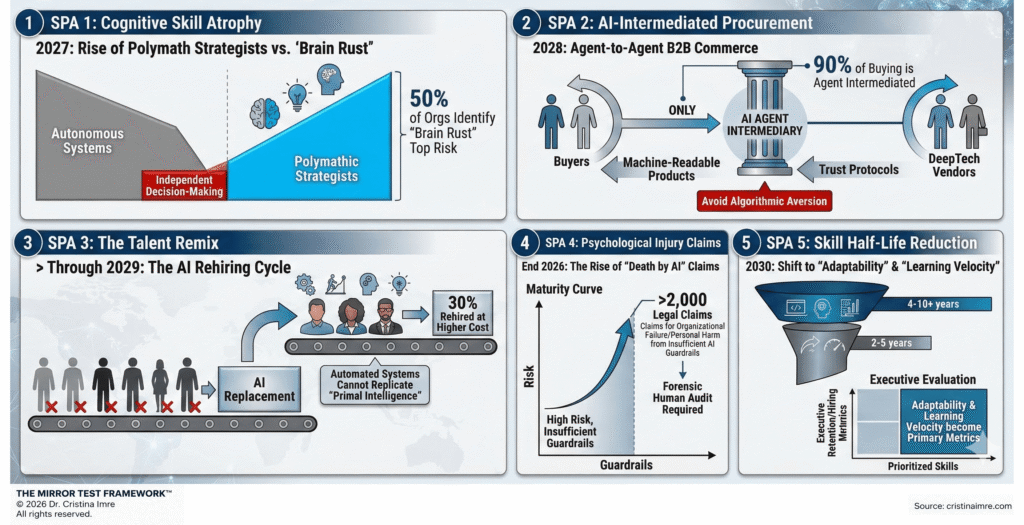
Strategic Planning Assumptions (SPAs): 2026-2030
The following strategic planning assumptions describe the future operational environment for DeepTech ventures. These predictions are based on observable signals in the labor market and the trajectory of AI adoption within the C-suite.
- SPA 1: Cognitive Skill Atrophy. Through 2026, Gartner predicts that 50% of global organizations will require ‘AI-free’ skills assessments due to critical-thinking atrophy – signaling that cognitive skill decay is already recognized as a board-level risk. This “Brain Rust” – the decay of independent decision-making – is a top strategic risk, leading to a resurgence in the value of polymathic strategists and human-centric architects.
- SPA 2: AI-Intermediated Procurement. By 2028, 90% of B2B buying will be AI agent intermediated, pushing over $15 trillion of B2B spend through AI agent exchanges. DeepTech companies will have to make their products machine-readable while maintaining human-centric trust protocols to avoid “Algorithmic Aversion”.
- SPA 3: The Talent Remix. Through 2029, 30% of employees terminated and replaced by AI will be rehired at higher costs as organizations realize that automated systems cannot replicate the “Primal Intelligence” required for complex problem-solving and ethical governance. Even more, by 2027, 50% of companies that attributed headcount reduction to AI will rehire staff to perform similar functions.
- SPA 4: Psychological Injury Claims. By the end of 2026, Gartner predicts that legal claims related to “Death by AI” – organizational failure or personal harm caused by insufficient AI risk guardrails – will exceed 2,000 cases, increasing the need for forensic human audits.
- SPA 5: Skill Half-Life Reduction. IBM and the World Economic Forum confirm the half-life of technical skills has already compressed to 2.5 years – down from 10–15 years in the 1980s. By 2030, this trajectory makes ‘Adaptability’ and ‘Learning Velocity’ the primary executive hiring metrics, not credentials or prior domain expertise.
The Anatomy of People Debt: Identifying the Hidden Liability
People Debt, much like technical debt, is a trade-off: organizations gain short-term velocity by avoiding difficult human conversations, but they accumulate “interest” in the form of decreased morale, executive churn, and strategic misalignment.
Inside DeepTech ventures, People Debt is often “Unintentional Debt,” occurring because founders move too fast in development while ignoring the psychological contracts that bind their teams together.
Technical debt is often quantifiable through system latency or code complexity metrics. People Debt, however, is a “Silent Saboteur” because it manifests in the nuances of leadership dynamics.
One of the primary drivers of People Debt is “Founder Drift,” a psychological phenomenon where a founder mentally disengages from their company 18 to 24 months after receiving significant funding.
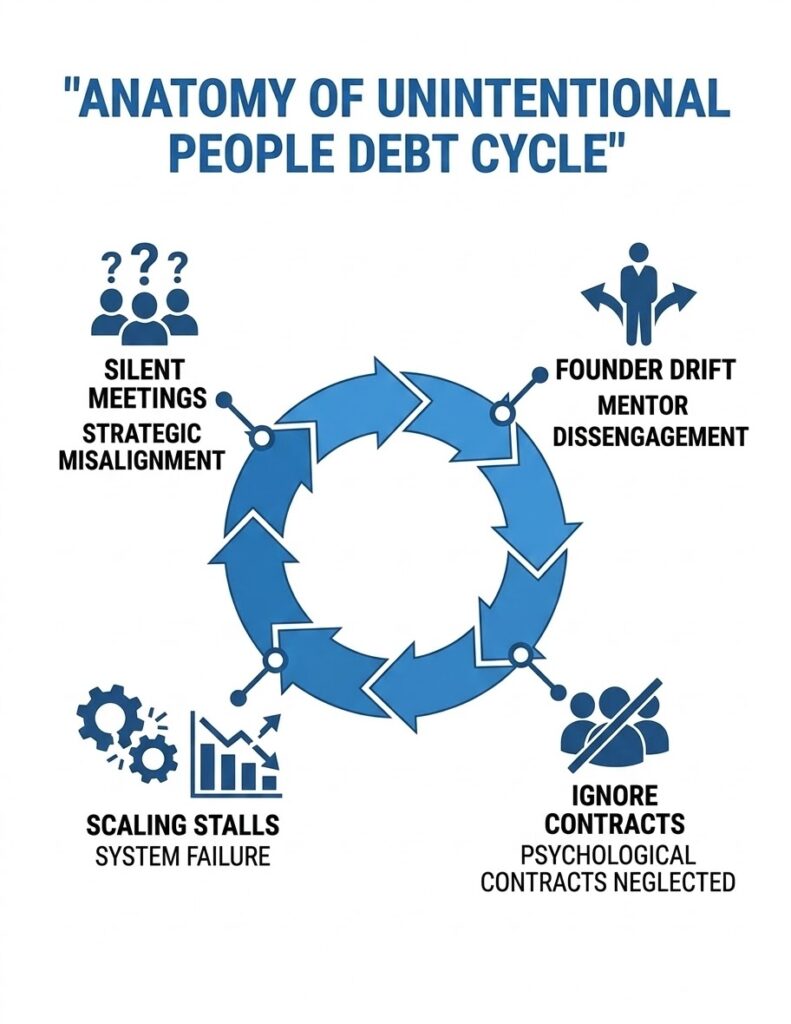
This drift transforms the “scrappy creator” into a “capital allocator,” leading to high-functioning burnout and defensive board updates. When a founder disengaged their own company, the resulting vacuum is filled by “Parallel Companies”, or different co-founders running different visions under the same name.
Feature | Technical Debt | People Debt (The Silent Saboteur) |
Visibility | Visible in code, documentation, and system performance. | Hidden in linguistic patterns, energy shifts, and “Shadow Meetings.” |
| ||
Mitigation | Code refactoring, system upgrades, automated testing. | The Mirror Test Framework™, hard conversations, Diagnostic Sprints. |
| ||
Amplifier | Slows software iteration and increases rework. | Triggers scaling stalls, partnership breakups, and cultural rot. |
| ||
Economic Cost | Quantifiable through developer time and maintenance. | 30-40% reduction in team efficiency (“Dysfunction Tax”). |
The Mirror Test Framework™ methodology posits that People Debt is the primary reason why 65% of high-potential startups fail due to co-founder conflict rather than lack of market fit. The number comes from Noam Wasserman with a dataset over 10,000 startup founders, and aligns perfectly with Dr. Imre’s findings from the startup world. If identified early with the Mirror Test Framework companies can prevent the “Slow Divorce” that consumes management attention and millions in legal fees.
The Mirror Test Framework™: A Human Forensic Audit
The Mirror Test Framework™ is structured as a five-step diagnostic protocol that utilizes “Human Forensic” expertise to analyze the delta between a leader’s stated strategy and their emotional reality. Dr. Cristina Imre operates as a human forensic examiner, identifying the “wanted artefacts” (the truth) from the case files of organizational behavior.
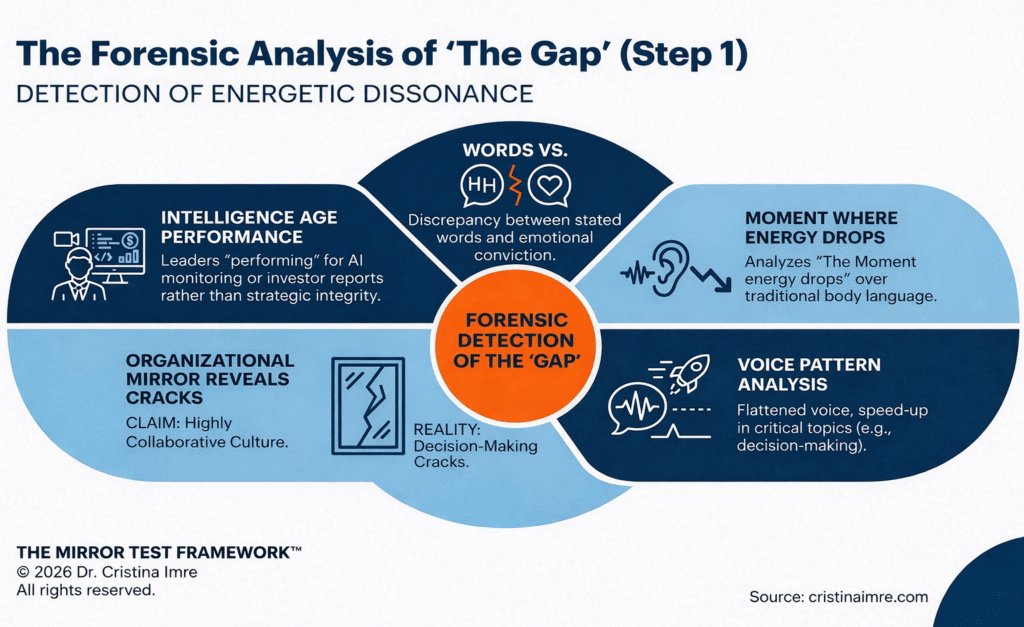
Step 1: Listen for the Gap (Energetic Dissonance)
The first step focuses on “The Gap” that is the discrepancy between words and emotional conviction. While traditional human resource audits focus on body language, the human forensic approach analyzes the “moment where energy drops”.
A founder might describe a “highly collaborative culture,” but if their voice flattens or they speed up when discussing decision-making processes, the “Gap” reveals a crack in the organizational mirror.
This detection is crucial in the Intelligence Age, where leaders are often “performing” for AI monitoring tools or investor reports rather than speaking from a place of strategic integrity.
This step leverages the Incongruence Principle and Vocal Prosody.
- The Mehrabian Formula: UCLA’s Albert Mehrabian established that when verbal and nonverbal messages are incongruent, listeners prioritize the nonverbal (38% vocal tone, 55% facial expression) over the verbal content (7%).
- Autonomic Stress Markers: Energetic drops or “flattening” are physiological markers. Emotional stress causes the cricothyroid muscles surrounding the vocal cords to contract, shifting the fundamental frequency (F0) away from a leader’s baseline.
- Acoustic Forensics: Scientific literature confirms that listeners “easily infer the emotional state of speakers through acoustic information,” specifically through prosody which conveys intent and emotional truth that language may attempt to mask.
- Visual Autonomic Stress Markers: The “Gap” is also visually verifiable through autonomic stress responses, most notably an accelerated blink rate (shutter speed), which involuntarily speeds up to minimize the time the eyes are closed when the mammalian brain detects a threat or hidden stress
Additionally, leaders experiencing cognitive dissonance will often subconsciously deploy barrier behaviors – such as suddenly buttoning a jacket or placing a glass of water between themselves and you – to create physical distance and protect themselves during uncomfortable topics.
Step 2: Track Repetition (Linguistic Patterns)
Linguistic patterns act as a subconscious map of what is missing in the organizational architecture.
Step 2 involves identifying “The Repeat” or the words mentioned three or more times in a brief window. For instance, a persistent repetition of the word “alignment” is a diagnostic signal that alignment is fundamentally broken.
Repeating “trust” signals a fear of betrayal, while repeating “strategy” often serves as a smokescreen for avoiding a specific human problem. In the MTF methodology, these repeats indicate where hope has replaced architecture, and where the real problems are.
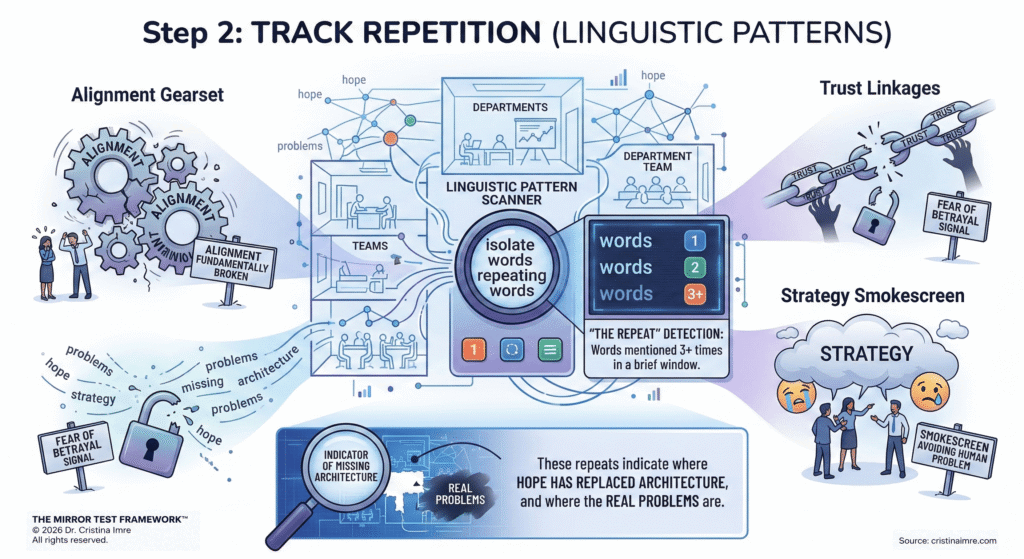
The scientific basis for treating repetition as a forensic signal emerges from the convergence of these three mechanisms. When Cognitive Load Theory, Speech Planning research, and linguistic stylistics all point to the same behavioral output – compulsive lexical recurrence under pressure – the repetition functions as foregrounding tension, signaling an internal struggle, repression, or denial during moments of high emotional pressure.
In forensic linguistics, this convergence principle is precisely what elevates a single behavioral cue into a reliable diagnostic marker: it is not the repetition alone, but the fact that three independent scientific frameworks predict it under the same psychological conditions.
When a leader repeats a word like “trust” or “alignment” without being prompted, they are not emphasizing a strength; they are involuntarily surfacing the exact terrain where their cognitive map has no settled answer.
Beyond repetition, human forensic analysis must also track pronoun absence, ambiguity, and non-answers. When a leader is under high emotional pressure or navigating deceptive terrain, the cognitive load often causes their speech to become devoid of personal pronouns, rely heavily on vague ambiguity, or utilize question reversals to subconsciously minimize guilt and psychological distance.
Step 3: Locate the Confidence Edge (Psychological Boundaries)
Every leader has a “Confidence Horizon” or the point where they stop knowing and start guessing. Step 3 locates the specific zones where leadership confidence evaporates.
For many DeepTech founders, this “Edge” resides in team dynamics or co-founder distrust. When questioned about these “Edge Topics,” a founder’s posture typically changes, and their answers become vague or over-explained, signaling where the real organizational problems live.
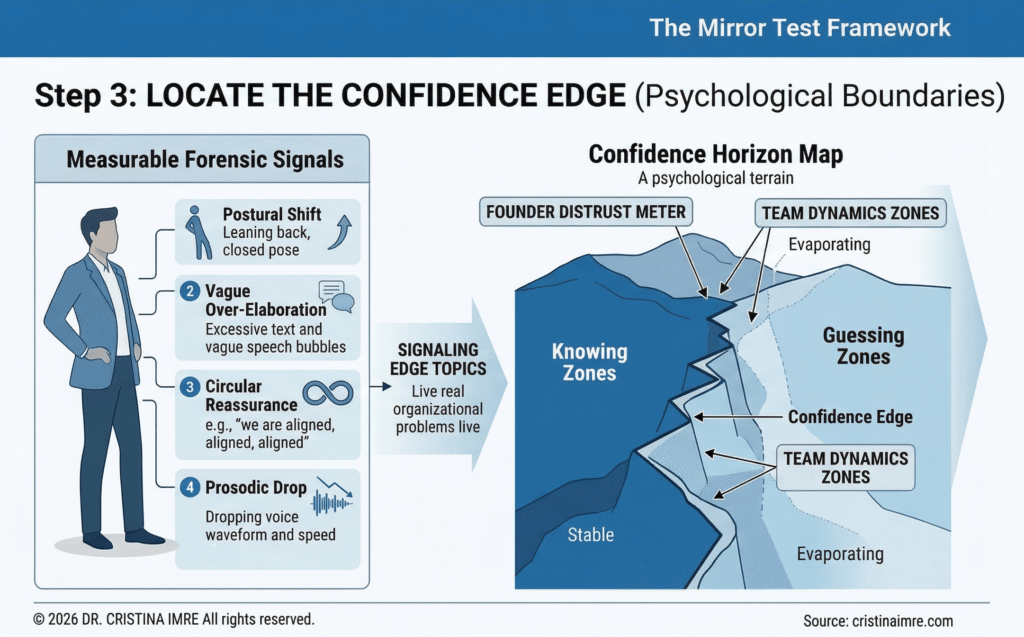
The scientific basis for locating the Confidence Edge as a forensic diagnostic zone emerges from the alignment of five independent research traditions.
- Argyris’s Theory of Action: Chris Argyris’s research proves that leaders hold “Model I” mental maps designed to maintain unilateral control and avoid embarrassment. The “Edge” is the point where this control collapses.
- Epistemic anxiety research distinguishes the verbal signature of genuine ignorance from strategic evasion.
- Autonomic physiology explains why the body signals threat before the mind has formulated the deception.
- Interpersonal Deception Theory explains the observable fragmentation that multi-channel management load produces under pressure.
- And evolutionary psychology explains why a trained observer detects the Edge faster than conscious reasoning can explain. The current framework utilizes the “Cheater Detection Module”, an adaptive algorithm in the brain that automatically looks for violations in social contracts.
When five frameworks converge on the same observable behavioral boundary like postural shift, vague overelaboration, circular reassurance, prosodic drop, that boundary is not an artifact of the diagnostician’s intuition. It is a measurable, defensible forensic signal that the leader has reached the limit of what they are willing or able to honestly address.
At this confidence edge, a leader’s “Locus of Control” dictates their response: those with an external locus of control will protect their ego by projecting blame onto outside forces, such as the market or unpredictable circumstances, rather than taking personal responsibility. Reaching these ambiguous edges also triggers the human “fudge factor,” a psychological flexibility that allows a leader to rationalize their own misbehavior and misalignment while still maintaining a positive, honorable self-image.
Step 4: Name it Directly (Radical Transparency)
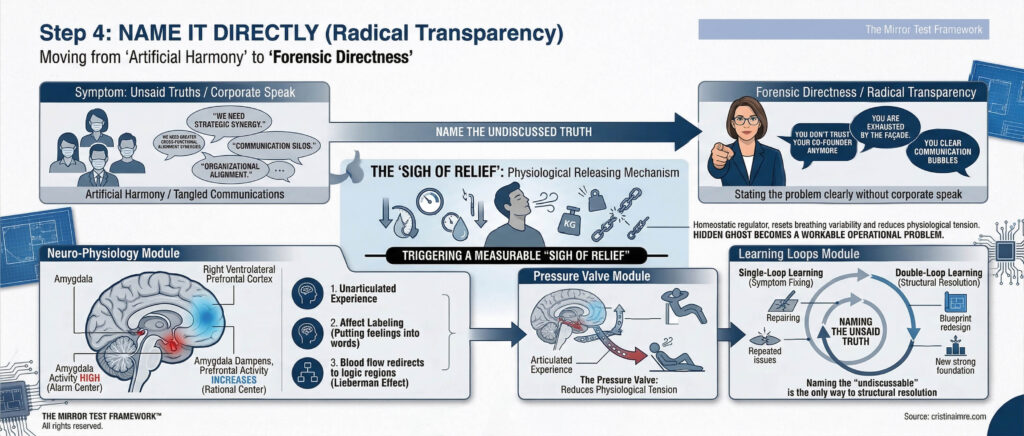
This step involves moving from “Artificial Harmony” to naming the unsaid truth. The human forensic expert must state the problem clearly without “corporate speak”. For example, instead of discussing “alignment challenges,” the expert might say: “You don’t trust your co-founder anymore”. Naming the truth directly triggers a “Sigh of Relief,” releasing the tension of maintaining a facade and turning a hidden ghost into a workable operational problem.
To successfully name the truth without triggering defensive reactance, this step leverages the PCP Model (Perception, Context, Permission) by shifting the founder’s perception of the crisis, redefining the context, and ultimately granting them the psychological permission to act. Furthermore, the forensic expert must frame this transparency by targeting the leader’s specific drivers on the Human Needs Map – such as Significance, Intelligence, or Acceptance – ensuring the message caters to their underlying psychological fears and needs.
This step is mainly supported by Affect Labeling and Prefrontal Activation.
- The Lieberman Effect: Neuroimaging research by Matthew Lieberman proves that Affect Labeling (putting feelings into words) dampens amygdala activity (the brain’s alarm center) and increases activity in the right ventrolateral prefrontal cortex (the rational center).
- The Pressure Valve: Articulating inner experiences redirects blood flow from emotional centers to logic regions, triggering a measurable “Sigh of Relief” that acts as a homeostatic regulator, resetting breathing variability and reducing physiological tension.
- Double-Loop Learning: Naming the “undiscussable” is the only way to move an organization from single-loop (symptom fixing) to double-loop learning (structural resolution).
Step 5: Fix the Foundation First (Operational Moratorium)
Step 5 is the most critical for DeepTech scaling. It demands a halt to technical scaling until the human foundation – trust, role clarity, and alignment – is repaired. Implementing AI strategies on a broken human foundation simply automates dysfunction, making the company “messy at 10x speed”. This step ensures that organizations achieve “Mirror-Resilience” before re-engaging growth engines.
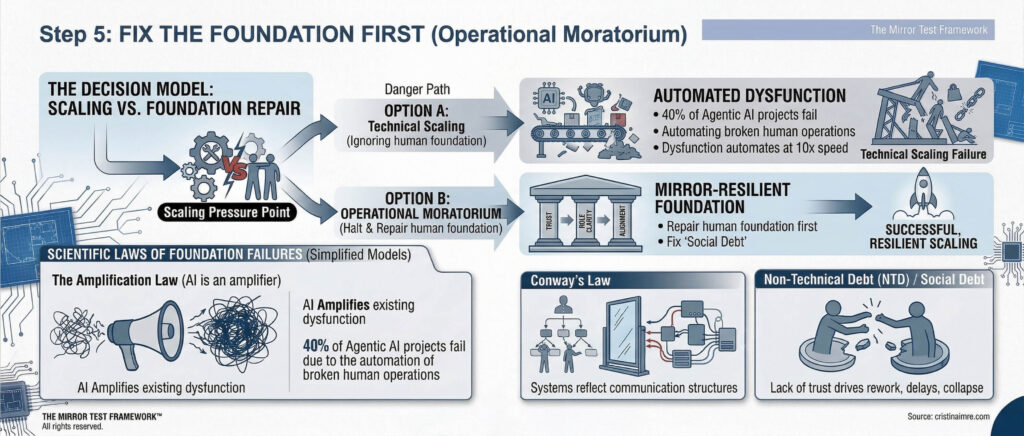
Fixing the foundation requires recognizing that human systems run on “psycho-logic” rather than pure rationality, meaning that automating a broken human layer with purely logical technology will inevitably fail. Moreover, if people debt and founder misalignments are not halted immediately, they act as a social contagion; a single unaddressed dysfunction mutates and spreads from person to person, silently resetting the acceptable moral code and eroding the conduct of the entire organization.
The scientific basis comes from Brooks’s Law, Conway’s Law, and Social Debt.
- The Amplification Law: AI is an amplifier, not a fixer; automating a messy process makes it 10x messier. In Dr. Imre’s advisory practice it was identified that 40% of agentic AI projects fail because they automate broken human operations.
- Conway’s Law: Systems designed by organizations are “copies of the communication structures of these organizations”. If the human foundation is fractured, the resulting DeepTech architecture will be fundamentally unstable.
- Non-Technical Debt (NTD): ArXiv research highlights “Social Debt” (strained relationships/lack of trust) as a primary driver of technical scaling failure, causing rework, delays, and total collapse.
Behavioral Science and Cognitive Biases in Leadership
The Mirror Test Framework™ is deeply rooted in behavioral science, specifically the distinction between “System 1” (fast, intuitive, bias-prone) and “System 2” (slow, analytical, logical) thinking. Most People Debt is accumulated when leaders make critical human decisions using System 1 heuristics, which are often clouded by cognitive biases.
Cognitive Bias | Impact on Leadership Decision-Making | Mirror Test Framework™ Diagnostic Signal |
Sunflower Management | Team members align with the leader’s views rather than stating facts. | Detection of the “Gap” between verbal consensus and energetic conviction. |
Loss Aversion | Leaders avoid difficult conversations (e.g., firing) to prevent immediate discomfort. | Naming the “Confidence Edge” where avoidance becomes a strategy. |
Imposter Syndrome | Founders hide in “Strategy” to avoid the risk of execution and exposure. | Identifying “The Repeat” of strategy-related words as an avoidance tactic. |
Confirmation Bias | Leaders only see data that supports their vision, ignoring team dissent. | Locating the “Vital Silence” – the truths the team knows but hasn’t said. |
In DeepTech scaling, these biases lead to “Founder Psychology” pitfalls. For example, “Fear of Peaking” causes successful founders to become stuck on identity rather than strategy, fearing that further growth might expose their initial success as luck. This leads to a “playing not to lose” mentality, which results in stagnation and allows more agile competitors to pass them. The Mirror Test Framework™ acts as a debiasing tool, forcing leaders to engage their System 2 thinking to audit their own behavioral architecture.
Scaling DeepTech: Protecting the "Human Edge" against AI Amplification
In the Intelligence Age, scaling is a binary outcome: it either amplifies your strength or it accelerates your collapse. DeepTech companies must navigate the “AI Paradox” – using machines to increase efficiency while protecting the “Human Edge”. Dr. Imre defines the Human Edge as the capacity for “Diagnostic Thinking” – the ability to see what doesn’t fit the pattern and to read between the lines.
AI is much better at “Executable Thinking” – pattern matching and process following. However, if an organization uses AI to eliminate all thinking, it develops “Brain Rust”.
In Dr. Imre’s advisory practice, within six months of total cognitive offloading, teams often lose their sense of purpose because human judgment was entirely offloaded. The Mirror Test Framework™ ensures that organizations use AI as a power tool to eliminate rote work (Type 1 thinking) so that humans have more capacity for high-value judgment (Type 2 thinking).
The Three-Question Test for Humanist Scaling
To preserve the Human Edge across AI-era organizations, the framework suggests a three-question test for every AI implementation:
- What requires pattern recognition? Automate this, as AI excels here.
- What requires reading what is NOT being said? Protect this, as it is the core of human judgment.
- What happens if we are wrong? If the cost is low, automate it. If the cost is existential (e.g., strategic direction, weaponization), require human judgment.
This approach ensures that AI enhances “Systemic Resilience” rather than creating a “Frictionless Trap” where one human crisis can derail the entire technical launch.
Case Analysis: Founder Dynamics and Organizational Implosion
The risk of organizational implosion is highest during the transition from “Seed” to “Series B.” Statistics indicate that 10% of co-founders end their relationship within the first year, and 45% break up within four years. When co-founder conflicts lead to breakups, 20% of those companies shut down entirely within 18 months.
The MTF (The Mirror Test Framework™) identifies “Founder Drift” as a primary cause of these failures. In a funded startup, the founder’s “psychological contract” changes; the company no longer feels like it belongs to their soul, but rather to board expectations and quarterly growth targets. This drift leads to three dangerous patterns:
- Becoming “Yes Men”: Founders stop fighting for their vision and start performing for the board.
- Hiding in “Strategy”: Spending weeks on five-year plans to avoid facing broken metrics in the present.
- Going Rogue: Escaping the daily grind by making erratic, high-risk pivots in the hope of a “miracle”.
By applying the MTF during investor due diligence, savvy investors can ask the right questions: “Tell me about a time you and your co-founder fundamentally disagreed” and “How do you handle the energy drop when discussing sales?”. The author claims that tracking these psychological indicators can increase the success ratio for startups from the traditional 1-in-10 to as high as 5-in-10.
Operational Resiliency vs. Frictionless Design
Many DeepTech companies suffer from the “Efficiency Trap” – prioritizing frictionless design (zero drag, maximum speed) over systemic resilience. Frictionlessness is a metric that leads to hyper-optimization for the “Happy Path”. In such systems, staffing is “Just-in-Time,” with teams running at 110% capacity with no margin for error or illness. One departure in a frictionless system creates an immediate crisis.
The MTF advocates for “Systemic Resilience” (Robustness), which accepts that “friction” is a feature that provides traction. Resilience requires building a “Snow Tires” layer of leadership assets:
- Redundancy as an Asset: Seeing extra staff or backup vendors as an insurance policy against global volatility.
- Cognitive Slack: Building in “idle time” so the team can process shocks without breaking.
- Governance as Engineering: Investing in systems that monitor the organizational environment, not just technical performance.
Attribute | Frictionless Design (Glass Cannon) | Systemic Resilience (Mirror-Resilient) |
Staffing Logic | Just-in-Time (JIT); Zero “slack.” | Redundancy as an insurance policy. |
Utilization Rate | Target 110%; Constant pressure. | Planned “idle time” for innovation/processing. |
AI Strategy | AI eliminates all “human drag.” | AI augments human “Diagnostic Thinking.” |
Stability Outcome | Fragile; Shatters upon context change. | Robust; Navigates “dirt roads” and market crashes. |
Critical Capabilities and Diagnostic Sprint Execution
Transitioning from the insights of the Mirror Test Framework™ to operational resilience requires a “Diagnostic Sprint” – a high-impact engagement focused on restructuring the human foundation. This sprint is particularly vital for post-funding startups and scale-ups where “Meeting after the meeting” culture begins to slow down product shipping.
The Scope of the Diagnostic Sprint
- C-Suite Alignment: Neutralizing co-founder friction and establishing a unified “Decision Logic”. This involves a behavioral audit of cultural alignment, often used to improve the understanding of cultural synergy in M&A contexts.
- Operational Integrity Audit: Stress-testing communication loops and role clarity against AI scaling. This audit identifies “Social Debt” (cliques/silos) and “Process Debt” (obsolete workflows).
- Human-AI Alignment Charter: Encoding human values into software deployment. This ensures that the organization is driven by “good hearts” and remains a “good ancestor” in the Intelligence Age.
At the end of the sprint, the organization receives a “Systemic Risk Map” – a prioritized visualization of where People Debt is highest – and a “Resilience Roadmap” with specific steps to fix the human foundation.
Strategic Recommendations: Scaling with Humanist Integrity
To achieve sustainable growth in the DeepTech sector while protecting humanist values, Dr. Cristina Imre recommends the following strategic mandates:
- Mandate Radical Candor over Artificial Harmony: Use the MTF Steps 1 through 4 to identify and resolve the “conversations every founder avoids” before they manifest as operational failures.
- Protect Type 2 Thinking: Implement the “Three-Question Test” to ensure that AI does not cause “Brain Rust” by eliminating human judgment in high-stakes areas.
- Track Psychological Lagging Indicators: Investors and boards should track founder energy, linguistic repeats, and executive churn as reliable predictors of future financial performance.
- Adopt a “Human-First” Scaling Sequence: Always fix the “human layer” (trust, alignment, communication) before implementing technical strategies or pivots.
- Build for Resilience, not just Efficiency: Incorporate cognitive slack and redundancy into the organizational design to ensure the venture can survive market volatility and the “messy middle” of AI transformation.
By applying these forensic human standards, DeepTech ventures can scale effectively without losing their Human Edge, ensuring that the technology they build serves a higher ethical goal and helps humankind evolve into a wiser, more resilient species. The MTF is not merely a diagnostic; it is the fundamental audit required for the survival of intelligence-age organizations.
Summary Table for Debate Reference
MTF™ Step | Supporting Field | Key Scientific Concept |
1. Listen for the Gap | Vocal Prosody / NLP | Autonomic Stress-Induced Vocal Distortion |
2. Find the Repeat | Cognitive Load Theory | Lexical Stalling and Semantic Saturation |
3. Locate the Edge | Behavioral Science | Model I Defensive Routines (Chris Argyris) |
4. Name it Directly | Neuropsychology | Affect Labeling & Amygdala Dampening (Lieberman) |
5. Fix Foundation | Software Engineering | Brooks’s/Conway’s Laws and Social Debt |
About the Author & Methodology
Dr. Cristina Imre is a medical doctor with advanced studies across psychiatry, psychology, behavioral science, neuroscience, NLP, evolutionary psychology, and anthropology – a polymath whose diagnostic lens spans the full spectrum of human cognition and organizational behavior.
With over two decades of cross-sector executive and advisory experience spanning AI, healthcare, fintech, manufacturing, and deep technology, operating across 5 continents and working directly with founders, C-suite executives, and distributed multinational teams – she has served in roles ranging from CEO and strategic advisor to fractional executive and coach, across startups to global corporations.
As the former CEO of an AI voice technology company and now Strategic Advisor to AI-era companies, she developed The Mirror Test Framework™ from direct pattern recognition across hundreds of high-stakes leadership diagnostics.
In her advisory practice, organizations that consistently deflect or avoid structured diagnostic protocols demonstrate a significantly elevated incidence of late-stage co-founder fracture, silent cultural debt accumulation, and operational fragility during AI scaling phases – dynamics that rarely surface in conventional due diligence but reliably appear under The Mirror Test Framework™ protocol. The framework operationalizes what was previously tacit expert judgment into a structured, repeatable, and auditable leadership assessment methodology.
References
Behavioral Science & Neuroscience
[1] Argyris, C. (1990). Overcoming Organizational Defenses: Facilitating Organizational Learning. Prentice Hall. Retrieved from: https://www.amazon.com/Overcoming-Organizational-Defenses-Chris-Argyris/dp/0205123384
[2] Lieberman, M. D., Eisenberger, N. I., Crockett, M. J., Tom, S. M., Pfeifer, J. H., & Way, B. M. (2007). Putting feelings into words: Affect labeling disrupts amygdala activity in response to affective stimuli. Psychological Science, 18(5), 421–428. Retrieved from: https://doi.org/10.1111/j.1467-9280.2007.01916.x
[3] Mehrabian, A. (1971). Silent Messages: Implicit Communication of Emotions and Attitudes. Wadsworth Publishing. Retrieved from: https://www.amazon.com/Silent-Messages-Albert-Mehrabian/dp/0534000592
[4] Vrij, A. (2008). Detecting Lies and Deceit: Pitfalls and Opportunities (2nd ed.). Wiley. Retrieved from: https://www.wiley.com/en-us/Detecting+Lies+and+Deceit%3A+Pitfalls+and+Opportunities-p-9780470516256
[5] Buller, D. B., & Burgoon, J. K. (1996). Interpersonal Deception Theory. Communication Theory, 6(3), 203–242. Retrieved from: https://doi.org/10.1111/j.1468-2885.1996.tb00127.x
[6] Cosmides, L., & Tooby, J. (1992). Cognitive adaptations for social exchange. In J. Barkow, L. Cosmides, & J. Tooby (Eds.), The Adapted Mind (pp. 163–228). Oxford University Press. Retrieved from: https://www.cep.ucsb.edu/papers/AdaptedMind92.pdf
[7] Kahneman, D. (2011). Thinking, Fast and Slow. Farrar, Straus and Giroux. Retrieved from: https://us.macmillan.com/books/9780374533557/thinkingfastandslow
[8] Sweller, J. (1988). Cognitive Load During Problem Solving: Effects on Learning. Cognitive Science, 12(2), 257–285. Retrieved from: https://doi.org/10.1207/s15516709cog1202_4
Organizational & Linguistic Research
[9] Conway, M. E. (1968). How Do Committees Invent?. Datamation, 14(4), 28–31. Retrieved from: http://www.melconway.com/Home/Committees_Paper.html
[10] Brooks, F. P. (1975). The Mythical Man-Month: Essays on Software Engineering. Addison-Wesley. Retrieved from: https://www.oreilly.com/library/view/mythical-man-month-the/0201835959/
[11] Tamburri, D. A., Kruchten, P., Lago, P., & van Vliet, H. (2019). What is Social Debt in Software Engineering?. arXiv preprint arXiv:1907.09525. Retrieved from: https://arxiv.org/abs/1907.09525
[12] Webster, D. M., & Kruglanski, A. W. (1994). Individual differences in need for cognitive closure. Journal of Personality and Social Psychology, 67(6), 1049–1062. Retrieved from: https://doi.org/10.1037/0022-3514.67.6.1049
[13] Gartner (2025). Strategic Predictions for 2026: How AI’s Underestimated Influence Is Reshaping Business. Gartner Research. Retrieved from: https://www.gartner.com/en/newsroom/press-releases/2025-10-strategic-predictions-2026
[14] Gartner (2025). Top Future of Work Trends for CHROs in 2026. Gartner Research. Retrieved from: https://www.gartner.com/en/human-resources/topics/future-of-work
[15] Gartner (2025). Top Strategic Technology Trends 2026. Gartner Research. Retrieved from: https://www.gartner.com/en/information-technology/insights/top-technology-trends
[16] Sonar Source (2024). What is Technical Debt? Causes, Types & Definition Guide. SonarSource. Retrieved from: https://www.sonarsource.com/learn/technical-debt/
[17] Imre, C. (2024). The Mirror Test: Solving Human Problems Disguised as Strategy. Medium / Tech Leadership Lab. Retrieved from: https://medium.com/@cristinaimre
[18] Imre, C. (2025). The Ghost in the Machine: AI Unbound. Medium / Tech Leadership Lab. Retrieved from: https://medium.com/@cristinaimre
Founder & Organizational Psychology:
[19] Wasserman, N. (2012). The Founder’s Dilemmas: Anticipating and Avoiding the Pitfalls That Can Sink a Startup. Princeton University Press. Retrieved from: https://press.princeton.edu/
[20] Rouse, E. D. (2016). Beginning’s End: How Founders Psychologically Disengage from Their Organizations. Academy of Management Journal, 59(4). Retrieved from: https://aom.org/
[21] CPP, Inc. (2008). Workplace Conflict and How Businesses Can Harness It to Thrive. CPP Global Human Capital Report. Retrieved from: https://www.themyersbriggs.com/
[22] Rotter, J. B. (1966). Generalized expectancies for internal versus external control of reinforcement. Psychological Monographs (80), Number 609
Behavioral Profiling & Applied Psychology:
[23] Hughes, C. (2020). Six-Minute X-Ray: Rapid Behavior Profiling. Applied Behavior Research. Retrieved from: https://www.chasehughes.com/6mxbookresources
[24] Hughes, C. (2023). The Behavior Ops Manual. Applied Behavior Research. Retrieved from: https://www.chasehughes.com/opsref
[25] Ariely, D. (2012). The (Honest) Truth About Dishonesty: How We Lie to Everyone – Especially Ourselves. HarperCollins Publishers. Retrieved from: http://www.danariely.com/
[26] Sutherland, R. (2019). Alchemy: The Dark Art and Curious Science of Creating Magic in Brands, Business, and Life. HarperCollins Publishers. Retrieved from: https://www.harpercollins.com/