
Redesigning for the 100-Year System: The Longevity Architecture of the Intelligence Age
Executive Summary: The Mismatch of the Century
In the Intelligence Age, we have reached a stage where medical science can perform what once looked like sorcery—upgrading the human biological clock through regenerative expertise. However, a fundamental contradiction remains: we are upgrading the human while forcing it to live inside a civilizational operating system built for a shorter-lived species. To move from merely surviving to thriving in a 100-year lifespan, we must move beyond treating the body and start redesigning the world we are sending that body back into. This is the dawn of Longevity Architecture.
1. The Biological Foundation: The “Disposable” Legacy
For two hundred thousand years, the human animal was not designed for long life. Evolution prioritized a “Disposable Model”—a biological design optimized for survival and reproduction, with no chapter for retirement. This was our baseline until the first great mismatch occurred: The Bargain.
When humans entered the agricultural era, we made a deal. We traded freedom for predictability, movement for storage, and biology for civilization. While this bargain allowed us to build nations and corporations, it created a rift between our ancestral biology and our modern environment. Today, as we stand on the cusp of the Intelligence Age, we are realizing that the old bargain has expired.
2. The Magnificent Machine on a Dirt Road
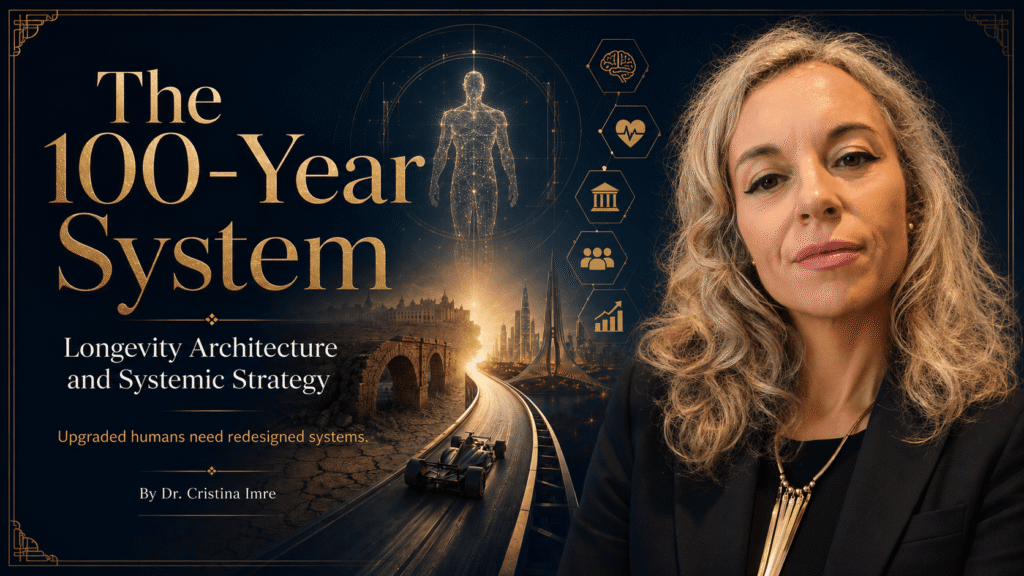
The current state of human performance can be summarized in a single forensic image: A Formula 1 car on a dirt road.
- The Machine: Through regenerative and longevity medicine, the human body is becoming magnificent.
- The Infrastructure: The societal operating systems we inhabit—retirement ages, fixed career paths, and legacy labels—are catastrophically outdated.
We tell highly experienced, capable leaders to “step aside” at age 60, exactly when many of them are entering their second prime. We treat wisdom as a legacy cost rather than a strategic asset. This is not just a social tragedy; it is a systemic failure of leadership architecture.
3. The Human Model Problem: Perception, Context, and Permission
The greatest hurdle in longevity is not always a lack of biological solutions; it is what I call the Human Model Problem. Patients and executives do not just need their biology fixed; they need perception, context, and psychological permission to live differently.
What happens when the body is ready for longevity, but society has not given the individual permission to live that way? We are currently treating the body in isolation while ignoring the outdated “Fiction” of the retirement age—a story we invented that has become a trap. To fix the “dirt road,” we must change the stories we tell about what it means to age.
4. People Debt™ and the Three Gaps of Longevity
When the system fails around the body, it accumulates People Debt. This is the hidden liability that erodes venture continuity and human potential. In the context of longevity and high-stakes operations, this debt manifests through three critical gaps:
- The Career Gap: Career debt wastes human wisdom by forcing early obsolescence.
- The AI Gap (Brain Rust): AI debt erodes Diagnostic Thinking—the unique human capacity to read between the lines and see what is not being said.
- The Data Gap: Data debt misreads the patient or the organization by relying on thin metrics rather than deep systemic integration.
These gaps are the warning lights on our civilizational dashboard. Ignoring them results in a “Dysfunction Tax”—a 30-40% reduction in team efficiency that mirrors the biological decay of an unmanaged human system.
5. Aesthetic Mismatch: Shrinking vs. Building Capacity
A forensic audit of our current culture reveals a dangerous Aesthetic Mismatch.
- The Beauty Story: Our current shared narrative asks the body to “disappear” or shrink.
- Longevity Medicine: True longevity science asks the body to build capacity for the long journey.
The human does not live in pieces; skin, joints, hormones, and identity are all part of one system. We must stop viewing longevity through the lens of vanity and start viewing it through the lens of Systemic Resilience.
6. Architecture of the 100-Year Human
So, how do we rebuild the road? The solution requires a new operating system and a new identity for leaders and practitioners alike. We must move away from “Artificial Harmony”—the state of prioritizing the appearance of consensus over the resolution of fundamental truths—and toward Radical Transparency.
Strategic Recommendations for a Multi-Stage Life:
- Scheduled System Reboots: We must stop viewing midlife as a crisis and start viewing it as a scheduled system reboot.
- AI as an Optimizer, Not an Architect: AI can optimize a technical system, but it cannot architect a meaningful human life.
- Redesigning the World: We must stop designing for short lives and start redesigning the world for the humans we are actually becoming.
- Human-Centric Trust Protocols: As we move toward a world of AI-intermediated procurement and agent-to-agent commerce, maintaining human-centric trust protocols is the only way to avoid “Algorithmic Aversion”.
Conclusion: We are the Asset Protectors
Stories do not change by accident; they change when enough people with enough authority stop repeating the old ones. The new story is not about staying young forever; it is about building the capacity to be an asset for the entire journey.
We are no longer just doctors, advisors, or executives. We are the architects of the 100-year human. It is time to stop repairing the old road and start building the new infrastructure of the Intelligence Age.