
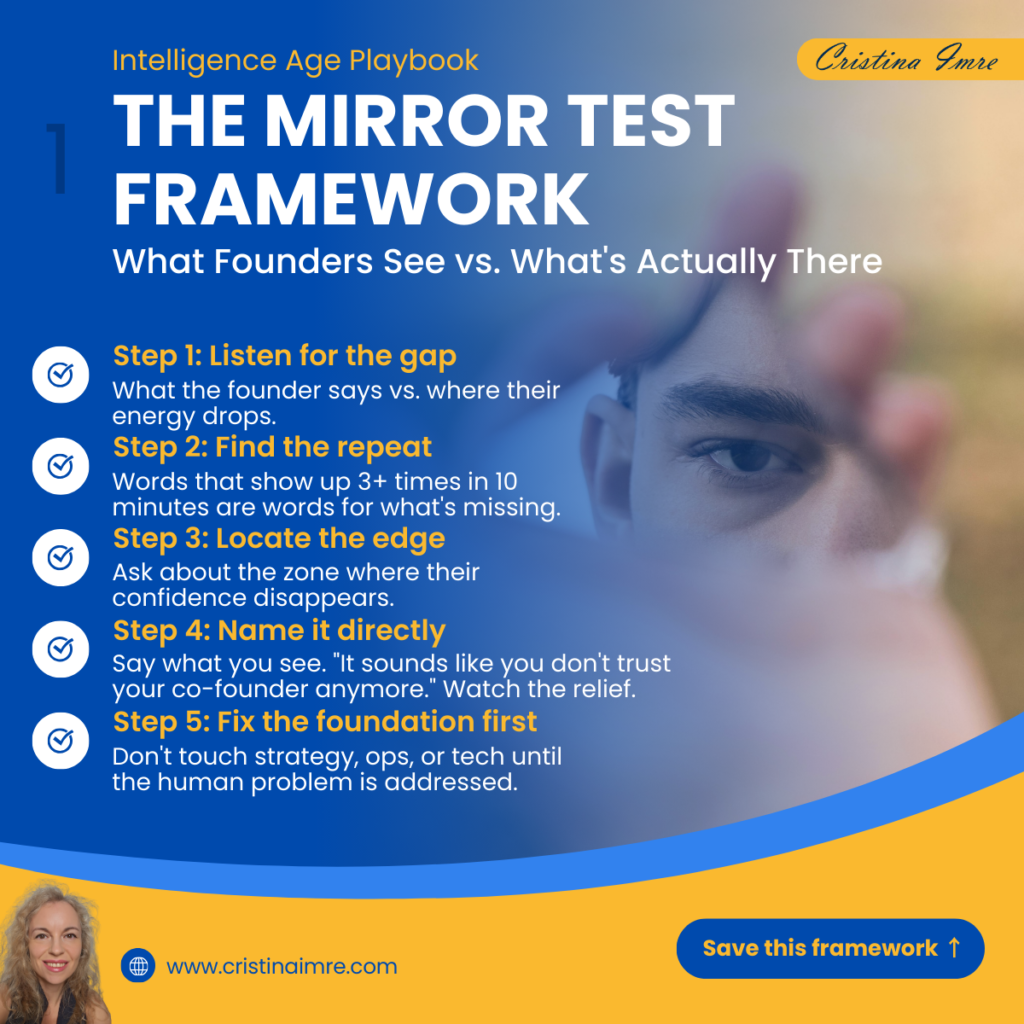
How The Mirror Test Framework™ identifies organizational breakdown at machine speed—before AI amplifies it into crisis
The Failure of Traditional Diagnostics in the AI Era
Gary Klein’s “Pre-Mortem” asks teams to imagine future failure.
McKinsey’s “7S Framework” audits bureaucratic structure.
Both assume you have time.
In 2026, with AI operating at machine speed and geopolitical volatility reshaping markets monthly, you don’t have 6 months for a McKinsey audit or 4 hours for a Pre-Mortem workshop.
You need to identify People Debt as it accumulates in real-time.
Because by the time traditional diagnostics flag the problem, AI has already operationalized your dysfunction at exponential scale.
The Core Problem: People Debt
People Debt is the organizational equivalent of technical debt.
It’s the accumulated cost of:
- Avoided conversations
- Misaligned co-founders
- Unclear decision authority
- Artificial harmony
- Role confusion
- Unaddressed performance issues
Like technical debt, it compounds.
Unlike technical debt, it’s invisible until it causes catastrophic failure.
Why Traditional Diagnostics Miss It
Gary Klein’s Pre-Mortem:
- Relies on imagination (subject to the same biases it tries to solve)
- Asks “what might go wrong in the future?”
- Assumes teams can objectively see their blind spots
- Problem: Founders are too “vision-locked” to imagine realistic failure
McKinsey’s 7S Framework:
- Maps organizational structure
- Audits systems, strategy, shared values, skills, staff, style
- Takes 3-6 months to complete
- Problem: By the time you finish the audit, the AI landscape has shifted three times
The Mirror Test™:
- Observes what’s breaking RIGHT NOW
- Identifies the delta between what founders SAY and what their nervous system SHOWS
- Diagnoses in 15 minutes
- Solution: Real-time detection before AI amplifies dysfunction
The Mirror vs. The Map vs. The Compass
McKinsey provides a Map:
It tells you where the departments are.
Useful when the terrain is stable.
Gary Klein provides a Compass:
It tells you where you might crash.
Useful when you have time to course-correct.
The Mirror Test Framework™ provides a Mirror:
It tells you who you actually are right now.
Essential when AI is operationalizing your reality at machine speed.
The Biological Reality of High-Speed AI Ventures
In traditional organizations, bottlenecks are strategic.
In AI-era companies, bottlenecks are human.
The pattern:
AI can execute in milliseconds.
Humans comprehend in minutes.
Bureaucracies decide in months.
The gap between these timescales is where companies fracture.
Not because of bad strategy.
Not because of market shifts.
Because the human layer couldn’t keep pace with machine execution.
The Mirror Test Framework™ Methodology: Technical Breakdown
After 20 years diagnosing scaling companies across five continents—from medical operations to AI ventures—I’ve identified five observable patterns that predict organizational breakdown before it becomes catastrophic.
Step 1: The Auditory Gap (Dissonance Audit)
What it detects: The delta between Executable Thinking (what founders say in the deck) and Somatic Conviction (where their energy actually sits).
The science:
Linguistic markers reveal cognitive dissonance before founders consciously recognize it.
When someone’s language is sharp but their energy drops, their nervous system is signaling misalignment their conscious mind hasn’t processed yet.
Observable patterns:
| What They Say | What I Observe | What It Means |
|---|---|---|
| “The team is killing it” | Voice flattens when mentioning co-founder | Co-founder friction unaddressed |
| “We’re very aligned” | Speeds up on product, slows on sales | Product/sales misalignment |
| “Everything’s on track” | Posture tenses | Strategic uncertainty masked |
Risk-to-ROI:
If undetected: Misalignment compounds. Decisions slow. Best people leave when they sense inauthenticity.
If detected early: 2-hour conversation resolves tension. Team realigns. Decision velocity increases.
Step 2: Linguistic Patterning (Repeat Analysis)
What it detects: Unresolved organizational tension through word repetition.
The principle:
The most important data in a company is often the word that’s MISSING from the boardroom.
But the second most important? The word that’s REPEATED.
Observable patterns:
| Word Repeated 3+ Times | What’s Actually Broken |
|---|---|
| “Alignment” | Fundamental misalignment exists |
| “Trust” | Trust has been violated |
| “Execution” | Team capability doubted |
| “Strategy” | Human problem being avoided |
| “Clarity” | Decision being postponed |
Real example:
Founder said “clarity” seven times in fifteen minutes.
I stopped him: “What decision are you avoiding?”
Long pause.
“I need to fire my co-founder. I’ve known for six months.”
Risk-to-ROI:
If undetected: Decision paralysis. 6+ months of organizational drag. Opportunity cost in millions.
If detected early: Difficult conversation happens. Structure adapts. Company accelerates.
Step 3: The Confidence Horizon (Edge Detection)
What it detects: The exact point where a leader’s intuition is being overruled by “Artificial Harmony.”
The principle:
Every leader has a Confidence Zone (topics where they feel absolute control) and a Confidence Edge (where certainty collapses).
The edge is where the real problem lives.
Observable patterns:
Confident zone: Product, technical architecture, market analysis
Confidence edge: Team dynamics, co-founder relationship, performance issues
The diagnostic:
Ask about confident topics → Specific, detailed answers
Ask about edge topics → Vague, defensive, or deflecting responses
Example:
Me: “How’s your relationship with your VP of Product?”
Confident founder: “Great. We shipped three features last week.”
What I notice: They answered OUTPUT, not RELATIONSHIP.
That’s the edge.
Risk-to-ROI:
If undetected: Real issues fester at the edge while founder focuses on comfortable zones.
If detected early: Naming the edge breaks denial. Real conversation becomes possible.
Step 4: Direct Naming (Breaking Artificial Harmony)
What it detects: Whether the organization can handle truth.
The principle:
The most dangerous moment in leadership is pretending harmony when none exists.
Artificial harmony is a systemic illness. It suppresses the organization’s “immune system” (ability to detect and kill bad ideas).
The test:
Name what everyone knows but nobody’s saying.
Observable patterns:
| Corporate Speak (Ineffective) | Direct Naming (Effective) |
|---|---|
| “I’m sensing some tension” | “I don’t think you trust your co-founder anymore” |
| “We might have alignment challenges” | “This VP isn’t working out and everyone knows it” |
| “Perhaps we could improve communication” | “You’re avoiding this conversation because you feel guilty” |
How you know you hit the bullseye:
Relief is the tell.
Tension breaks. Founder exhales. “Oh thank god someone finally said it.”
Risk-to-ROI:
If avoided: Artificial harmony persists. Bad ideas proliferate unchallenged. AI operationalizes dysfunction.
If named directly: Truth becomes discussable. Team can address reality. Solutions become possible.
Step 5: Foundation Stabilization (Sequence Discipline)
What it detects: Whether the company is building strategy on stable or unstable foundation.
The principle:
Do not redesign strategy while trust is unstable.
This is the rule that breaks most companies.
The fatal sequence:
- Human layer is misaligned (trust broken, roles unclear, co-founders diverging)
- Company implements AI transformation / GTM pivot / org restructure
- AI amplifies the misalignment at 10x speed
- Catastrophic failure
The correct sequence:
- Fix human layer FIRST (conversations, trust, alignment, roles)
- THEN execute strategy (AI, GTM, growth)
Observable patterns:
Unstable foundation checklist:
☐ Leadership team doesn’t fully trust each other
☐ Someone on exec team isn’t working (everyone knows)
☐ Co-founders want different things (unspoken)
☐ Key decisions stuck >1 month
☐ “Shadow meetings” happen after official meetings
If 2+ checked: Foundation is unstable. Strategy work will fail.
Risk-to-ROI:
If foundation ignored: Every dollar invested in strategy, AI, or growth amplifies dysfunction. Compounding losses.
If foundation fixed first: Strategy executes cleanly. AI amplifies excellence. Exponential returns.
Comparative Analysis: The Intelligence Age Requires Different Tools
| Feature | McKinsey 7S | Klein’s Pre-Mortem | The Mirror Test™ |
|---|---|---|---|
| Primary Goal | Strategic Alignment | Risk Mitigation | Systemic Resilience |
| Speed | 3-6 Months | 2-4 Hours | 15 Minutes |
| Focus | Structure/Systems | Future Scenarios | Human Dissonance |
| Detection Method | Document Review | Imagination Exercise | Real-Time Observation |
| Era Designed For | Industrial/Information Age | Cognitive Bias Era | Intelligence Age |
| AI Compatibility | Reactive (audits after implementation) | Predictive (imagines failure) | Proactive (detects before AI amplifies) |
| Bottleneck Addressed | Structural | Cognitive | Biological |
| Cost | $500K-$2M+ | Internal time cost | $25K-$50K diagnostic |
Why Gary Klein’s Pre-Mortem Fails in the Intelligence Age
Gary Klein’s “Pre-Mortem” is brilliant cognitive exercise for a slower era.
How it works:
Teams imagine they’re in the future, looking back at a project that failed. They identify what went wrong.
The limitation:
It relies on imagination, which is subject to the very same biases it tries to solve.
In AI ventures, founders are too “vision-locked” to imagine realistic failure.
They see the map (market opportunity, technical solution, growth trajectory).
They don’t see themselves (co-founder misalignment, performance issues, decision paralysis).
The Mirror Test Framework™ vs. Pre-Mortem
Pre-Mortem approach:
“Imagine we failed. What happened?”
Limitation: Founders imagine strategic failures (market shift, competitor move, technology obsolescence).
They don’t imagine: “We failed because I couldn’t tell my co-founder we want different things.”
Mirror Test approach:
“What’s breaking RIGHT NOW that you’re not addressing?”
Advantage: Observes CURRENT dissonance before it compounds.
Detects: “Your energy drops when you mention your co-founder. That’s data.”
From Post-Hoc Narrative to Real-Time Diagnostic
Pre-Mortem = Post-Hoc Narrative
Imagines past failure from future vantage point.
Useful for strategic planning in stable environments.
Mirror Test = Real-Time Diagnostic
Observes present dysfunction through biological signals.
Essential for high-velocity environments where AI amplifies everything.
We don’t care what MIGHT happen.
We identify what IS ALREADY BREAKING based on linguistic and energetic dissonance happening in the room today.
The “People Debt” Maturity Model
Self-assess your organization’s current state:
Level 1: Artificial Harmony (Crisis Imminent)
Characteristics:
- No visible disagreement in leadership meetings
- Decisions made “unanimously” in 10 minutes
- Real opinions emerge in Slack/hallways after meetings
- Team says “we’re aligned” but executes conflicting priorities
People Debt: Critical. High risk of catastrophic failure.
AI Risk: AI will operationalize conflicting strategies simultaneously.
Intervention Required: Immediate. Break artificial harmony before implementing any AI.
Level 2: Acknowledged Tension (Unstable)
Characteristics:
- Team knows there are issues but avoids naming them
- Conflicts exist but stay below surface
- Performance issues unaddressed for >3 months
- Strategic decisions delayed by “need more data”
People Debt: High. Compounding daily.
AI Risk: AI will amplify indecision and create execution paralysis.
Intervention Required: Urgent. Name what’s unspoken. Address performance issues.
Level 3: Active Conflict (Inflection Point)
Characteristics:
- Disagreements happening but not productively
- Team arguing about symptoms, not root causes
- Blame culture emerging
- Trust eroding but not yet broken
People Debt: Moderate but accelerating.
AI Risk: AI will amplify blame patterns and create toxic feedback loops.
Intervention Required: High priority. Shift from blame to systems thinking.
Level 4: Productive Conflict (Building Resilience)
Characteristics:
- Team disagrees openly in meetings
- Conflicts get resolved in real-time
- “I disagree” is normal, not threatening
- Decisions stick after disagreement
People Debt: Low. Manageable.
AI Risk: Minimal. AI amplifies healthy debate into better decisions.
Maintenance Required: Quarterly foundation checks.
Level 5: Systemic Integrity (AI-Ready)
Characteristics:
- Zero delta between stated strategy and actual execution
- Disagreement is productive and welcomed
- Performance issues addressed within 30 days
- Trust enables machine-speed decision-making
People Debt: Near zero.
AI Opportunity: Maximum. AI amplifies excellence exponentially.
Status: Ready for aggressive AI implementation and scaling.
Real-World Application: Where The Mirror Test Framework™ Has Been Deployed
Case Study 1: DeepTech Robotics Venture
Context: Series A company, 45 people, implementing AI across manufacturing operations.
Problem Detected (Mirror Test, 15 minutes):
- CTO and COO had fundamentally different visions for AI integration
- Both claiming “alignment” in board meetings
- Energy dropped when mentioning each other’s names
- Word “strategy” repeated 8 times in 20 minutes
Intervention:
- Named the misalignment directly
- Facilitated 2-hour conversation
- Clarified distinct ownership: CTO owns AI architecture, COO owns operational implementation
- Rebuilt decision authority matrix
Result:
- AI implementation accelerated 3x
- Decision velocity increased
- Both executives reporting higher satisfaction
- Company on track for Series B
ROI: 15-minute diagnostic + 2-hour conversation saved 6+ months of organizational drag.
Case Study 2: AI SaaS Startup (Tech Leadership Lab)
Context: Pre-seed company, 8 people, seeking $2M raise.
Problem Detected (Mirror Test, 10 minutes):
- Co-founders using word “clarity” repeatedly
- Vague on decision authority
- Defensive when asked about token economics
- No answer to “what’s a token worth to your business?”
Intervention:
- Identified that co-founders wanted different outcomes (one wanted lifestyle business, one wanted unicorn)
- Named the divergence directly
- Facilitated decision: restructure partnership or part ways
Result:
- Co-founders restructured
- One became advisor with small equity
- Other became sole CEO with clear vision
- Raised $2.5M within 60 days
ROI: Early detection prevented catastrophic co-founder blow-up post-funding.
The AI-Era Amplification Effect
Why this matters NOW more than ever:
Traditional diagnostics were built for environments where:
- Execution happened at human speed
- Dysfunction degraded slowly
- You had quarters to course-correct
AI changes everything:
AI operates at machine speed.
AI amplifies whatever exists.
AI turns small misalignments into systemic failures in weeks, not months.
The Amplification Pattern:
Without AI:
- Sales and Product teams misaligned
- Sales promises features Product won’t build
- Product builds features Sales won’t sell
- Degradation happens over 6-12 months
- Damage: Missed revenue, frustrated customers
With AI (same misalignment):
- AI customer service learns from both teams
- AI gives conflicting information based on which team’s data it pulls
- Customer satisfaction drops 25 points in 8 weeks
- Damage: Brand destruction, customer churn, existential crisis
The Mirror Test catches this BEFORE AI implementation.
Why Traditional Consulting Fails AI Companies
McKinsey’s approach:
- Audit current state (3 months)
- Design new structure (2 months)
- Implement changes (6 months)
- Total: 11 months
What happens in those 11 months for an AI company:
- AI models evolve 3 generations
- Competitive landscape shifts entirely
- Team burns out from “change management”
- Market opportunity closes
The Mirror Test approach:
- Diagnose current state (15 minutes)
- Name what’s broken (immediate)
- Fix foundation (days to weeks)
- Implement AI on stable foundation
- Total: Weeks, not months
The Technical White Paper: Full Diagnostic Protocol
The Mirror Test™ is a high-stakes protocol.
The full technical methodology includes:
- Complete diagnostic question bank (72 questions across 5 domains)
- Biological signal detection training (voice, posture, energy)
- Linguistic pattern recognition framework
- Artificial Harmony detection matrix
- People Debt quantification model
- Foundation stability assessment
- AI-readiness scoring rubric
- Intervention protocols by severity level
Download the complete technical white paper and diagnostic roadmap:
[→ Get The Mirror Test™ Technical White Paper]
Who Should Use The Mirror Test Framework™
Founders & CEOs:
- Before raising capital (ensure co-founder alignment is real)
- Before implementing AI (verify foundation is stable)
- When growth stalls (diagnose what’s actually broken)
- Before org restructures (fix humans before changing structure)
Investors & Board Members:
- Due diligence on portfolio companies
- Early warning system for People Debt
- Pre-mortem before major strategic pivots
- Retention diagnostic when key people leave
Executive Teams:
- Quarterly foundation checks
- Post-funding integration assessment
- Pre-acquisition cultural diagnostic
- Crisis intervention when trust erodes
The Mirror Test™ Certification Program
For advisors, coaches, and consultants who want to deploy The Mirror Test™ with their clients:
Level 1: Foundation Diagnostic
- 72-question diagnostic protocol
- Biological signal detection
- Linguistic pattern recognition
- 2-day intensive training
Level 2: Intervention Design
- Breaking Artificial Harmony techniques
- Conversation facilitation protocols
- Foundation stabilization roadmaps
- 4-week practicum
Level 3: Master Practitioner
- AI-readiness assessment
- Systemic resilience architecture
- Organizational immune system design
- 6-month mentorship
Interested in certification? [Contact here]
The Evolutionary Leap
Industrial Age → Information Age → Intelligence Age
Each era requires different diagnostic tools:
Industrial Age: Efficiency audits (time-motion studies)
Information Age: Strategic frameworks (McKinsey 7S, Porter’s Five Forces)
Intelligence Age: Real-time biological diagnostics (The Mirror Test™)
Why?
Because in the Intelligence Age, the bottleneck is no longer strategic or structural.
The bottleneck is biological.
Can your human layer keep pace with machine execution?
Can your organization maintain trust at machine speed?
Can your team make decisions faster than AI creates new realities?
The Mirror Test™ answers these questions in 15 minutes.
Not 6 months.
Start Your Diagnostic
Ready to assess your organization’s People Debt before AI amplifies it?
Option 1: Self-Diagnostic
Download the technical white paper and run the assessment yourself.
→ Get The White Paper
Option 2: Facilitated Diagnostic
Schedule a 15-minute Mirror Test diagnostic with Dr. Cristina Imre.
→ Book Discovery Call
Option 3: Enterprise Program
Deploy The Mirror Test™ across your portfolio or organization.
→ Contact for Enterprise
About Dr. Cristina Imre
Creator of The Mirror Test Framework™
20+ years diagnosing organizational health across five continents.
Background:
- MD, Behavioral Science
- Tech Ethicist & Strategic Advisor
- Fractional Executive for AI-era companies
- Founder, Tech Leadership Lab
- Strategic Advisor: CHVO Robotics, Fountech AI Portfolio, RAIDS AI
Expertise:
- Founder psychology assessment
- Organizational diagnostics at machine speed
- AI-readiness evaluation
- People Debt quantification
- Systemic resilience architecture
The Mirror Test Framework™ has been deployed in:
- DeepTech robotics ventures
- AI SaaS startups
- Enterprise AI transformations
- VC portfolio diagnostics
- Executive team interventions
The choice is binary:
Run The Mirror Test before implementing AI.
Or watch AI amplify your People Debt into an existential crisis.
The reflection will show you exactly what’s broken.
Then you just need the courage to fix it.
Ready for the full protocol? Download the Mirror Test Framework™ White Paper.
© 2026 Dr. Cristina Imre. The Mirror Test Framework™ is a registered trademark.