
A frontier lab just put its compute costs in a filed document. For the first time, the market can price the gap between what is being built and the demand that is supposed to pay for it.
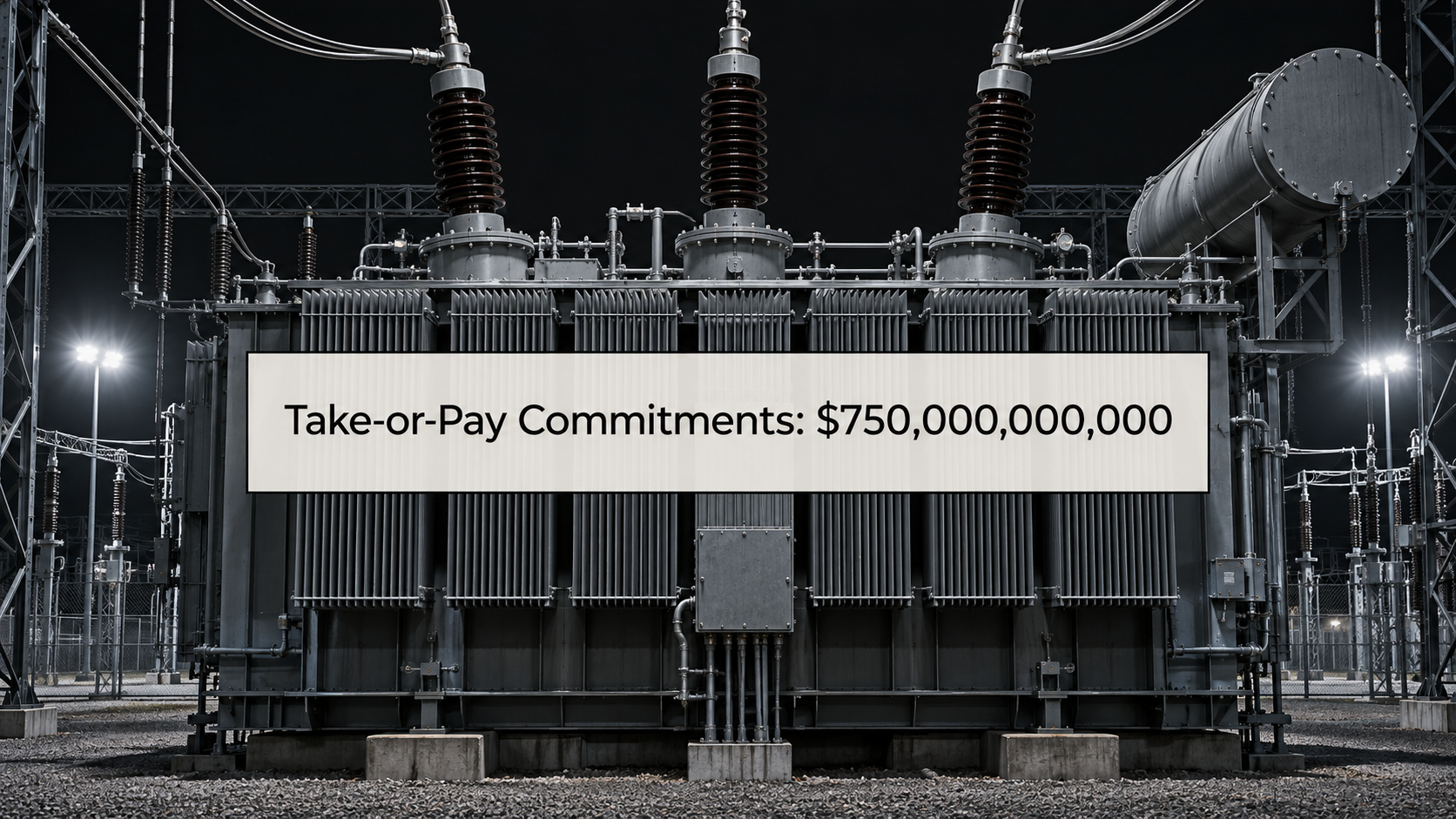
What happens when an AI company spends $2 billion a month on compute, but is legally locked into paying $3.1 billion? You get a $750 billion liability trap that the headlines completely missed.
In late September, Anthropic filed its IPO prospectus. It is the first time a frontier AI lab has opened its books to the public. And inside that filing, the gap between what is being built and the demand that is supposed to pay for it stopped being a theory. It became a line item.
On Sunday, I asked who eats the bill when the grid is financed on a promise. In September, a frontier lab handed the answer to the SEC. Last week, the market wiped out $1 trillion in a single day. The answer is inside a filed document, and it comes down to a single contract clause. Here is what the document says, and what it actually means.
The paper trail
Anthropic’s IPO filing lists more than $750 billion in computing deals. Firm commitments and estimated future spending, taken together. That is not a forecast. That is a bill.
Here is the part the headlines will skip. Most of those commitments cannot be canceled. The deals with Microsoft, Google, and Amazon require Anthropic to pay regardless of actual usage. In power contract language, that has a name: take-or-pay. The company is on the hook for the capacity whether or not anyone uses it. The cost is locked before the demand is proven.
That is the exact move I described when I asked who eats the bill when the grid is financed on a promise. The money goes in, the infrastructure is committed, and if the demand lands smaller than promised, the bill does not disappear. It moves. Now the same mechanism sits in a filed document, with a number in it, instead of a data center’s power contract.
Who is on the other side
| Commitment | Amount | Window |
|---|---|---|
| Google TPU capacity ($114.5B direct to Google + $161.2B Broadcom leases + additional TPU) | ~$400 billion | mostly next 7 years |
| SpaceX (formerly xAI) computing | up to $120.5 billion | through 2029 (~$3.1B/month at full capacity) |
| Amazon Web Services | at least $110 billion | 10 years, through 2036 |
| Microsoft Azure | at least $44.9 billion | Nov 2026 to May 2033 |
| Nscale + Lambda (Nvidia-powered) | ~$86 billion combined | multi-year |
Read that as a portfolio, not a spending plan. The largest single arrangement is a five-year lease from Broadcom. The second largest is a computing deal with a company that runs a rival AI lab. The bill is not being paid to build AI. It is being paid to a set of counterparties, most of whom are not going to be around to argue about whether the demand showed up.
The math the headlines are skipping
The filing says Anthropic has “consistently operated in a compute-constrained environment where customer demand exceeds available compute.” Fine. But in the second quarter it spent less than $2 billion a month on compute and infrastructure. The SpaceX deal alone is expected to cost about $3.1 billion a month once it is fully delivered. The commitments assume the demand keeps growing, faster than the company is currently spending. That is not a plan. That is the bet.
And the bet has a thin base. Nearly a quarter of last year’s revenue came from two customers. The filing says its largest clients are not locked into long-term contracts and could cut or stop spending. So the company is committing to multi-year, non-cancellable capacity, funded on a demand that a meaningful share of it can walk away from at any time.
The numbers the company reported
The loss is worth stating plainly. Anthropic reported a $42 billion net loss in 2025. About $34 billion of that is an accounting charge tied to financing that could turn into shares, not cash the company spent. But the operating loss widened to more than $8 billion, and the second quarter still showed a $66 billion net loss against $11.6 billion in revenue. The revenue is real and it is growing fast, up from $787 million a year earlier. The bill is just, for now, much larger.
Why the market moved last week
The document did not move the market by itself. What moved the market is that the market finally had a document to price.
Google had its worst day ever on the 29th, falling more than 12% and wiping out roughly $500 billion, after it told investors it had burned more cash in the summer than in the spring on AI, even as search revenue growth slowed. The next day the Nasdaq dropped nearly 3% and roughly $1 trillion came off the tech sector. The stated reason was AI spending. The actual reason is the gap in that prospectus, made legible.
And the man who called the last bubble has taken a position on this one. Steve Eisman has argued that Anthropic left its most recent quarter out of the filing on purpose, because the newer numbers would show growth slowing. Whether or not he is right, the fact that his question is the question is the point. The market is no longer asked to believe the story. It is being handed the document.
The shift: from a promise to a filed document
For two years the bill on AI was a promise. We are investing for the long term. A promise is free to make. Nobody prices a promise, because there is nothing to price.
In October I wrote that the brake on AI had stopped being a decision someone made in a lab. It had become a legal object. Something that can be enjoined, sued over, and priced. A judge, a regulator, and a customer could each put their hand on it.
This month the bill did the same thing. Now it is a filed document with a number in it, and a market that can price it. The brake in October was a legal object. The bill in November is one too. And the referee that prices both is not a court and not a regulator. It is the market, and the market does not take meetings.
The bottom line
When a company worth, on the company’s own target, more than $2 trillion goes public in a few weeks, the gap between the buildout and the load stops being a theory. It becomes a number. And the number has someone on the hook for it. That was the question I started with. Now it has an answer.
Likely to happen. Within 90 days, the next major AI-adjacent filing or earnings report gets re-rated on cash burn, with “long-term investment” as the stated reason and the market pricing the gap between committed spend and proven demand.
Less likely, but possible. The Anthropic offering prices at or above its $2 trillion target, and the market decides to fund the bill. That would be the tell that the “investing for the long term” framing is still being believed at scale.
When the bill is a document, the question stops being whether you will pay. It becomes who is left holding it when the demand does not show up.
The most expensive risk is the one your organization cannot name.
If your organization has agents in production and no owner for the compute bill behind them, you are carrying a liability with a countdown. The Mirror Test exists to surface it before it gets expensive.
The white paper is free, gated by email. The Forensic Read is the 14-day diagnostic.
Cristina Imre is a forensic architect of organizations and the creator of the Mirror Test Framework™ and People Debt™. She helps boards and executives read the human system behind the numbers, before the distortion reaches the balance sheet.
🍀